


DPF Repair for a Plugged Filter and Failed Regens
DPF repair at Bodacious Diesel starts with the question a quick fix skips: why did the filter fill up? The filter is built to catch soot and burn it off, so when it plugs, the engine or the way the truck gets driven is feeding it more than it can clear.
A filter that cleans itself, until it can't
The diesel particulate filter sits behind the DOC, an oxidation converter. Its ceramic channels are blocked at alternating ends, so exhaust pushes through porous walls and soot stays behind.
Soot burns off
Soot is unburned carbon. Given enough heat it burns away inside the filter, and that burn is a regeneration. A healthy truck does it without the owner noticing.
Ash stays put
Ash is left after soot burns, mostly from oil additives. It never burns off. Over many miles it packs the channels, so an older filter regens more often even on a healthy engine.
Every DPF job ends with the filter, sensors and regen strategy working the way the factory designed them. We do not do delete work.
Passive, active and forced regens
Pick one to see how it works and what we check.
Burning soot as you drive
Under steady load, like highway miles or a trailer, the exhaust runs hot enough that soot burns slowly on its own.
- Town driving never builds that heat
- A weak DOC cuts the heat the filter sees
- We compare exhaust temperatures across each part
The computer turns up the heat
When the soot estimate climbs high enough, the engine computer adds extra fuel that burns in the DOC instead of the cylinders, and that heat clears the filter. You may notice a hot smell or a higher idle.
- Shutting off mid-regen leaves it half done
- Bad temperature or pressure sensors can stop it
- We watch a regen live on the scan tool
A parked regen on our terms
A forced or parked regen is started with a scan tool while the truck sits still. We only run one after the sensors check out and the oil is not thinned with fuel.
- A step in the repair, never the whole repair
- A filter packed with ash will not clear this way
- Repeat regens with no cause found waste money
What a struggling filter feels like
They creep in slowly, then reduced power arrives all at once.
| What the truck is doing | What it often points to |
|---|---|
| Regens every day or two | Extra soot from the engine, an ash-loaded filter, or a sensor giving a false reading. |
| Filter full message, then reduced power | Soot passed the limit before a regen could finish. Common on trucks that never get a long run. |
| Pressure sensor codes, truck runs fine | A cracked, melted or plugged sensor hose, or the sensor itself. The filter may be fine. |
| Black smoke from a truck with a DPF | Soot getting past a cracked filter. |
Short trips, idling and cold mornings
A diesel that runs ten minutes to the job site and idles to keep the cab warm makes soot all day and rarely gets hot enough to burn it. Regens get cut off at shutdown and the load stacks up. Cold starts add more.
- Regens interrupted at every stop
- Thin air, where a tired turbo shows up as extra soot
- 01Heavy towing with an injector, EGR or boost fault adding soot on every climb
A plugged DPF is often a symptom
Fix the filter without fixing what loaded it, and you pay for the job twice.
Injectors
An injector that drips, sticks or sprays a poor pattern leaves fuel partly burned, and that becomes soot.
Diesel injector repairEGR system
A stuck EGR valve throws off the air mix and drives soot up. Coolant from a leaking EGR cooler can foul the filter for good.
EGR cooler replacementTurbo and air side
Low boost means too little air for the fuel. A sticking VGT, a boost leak or a turbo pushing oil all load the filter.
Diesel turbo repairA differential pressure sensor reads the pressure before and after the filter, and the computer uses it to judge soot load. Its hoses run next to hot exhaust and crack, melt or plug. A bad reading triggers needless regens or hides a full filter, so it gets tested first.
Our DPF sequence, in order
Each step decides whether the next is needed, so a hose problem never becomes a filter bill.
Read the data
Codes, soot load, regen history and pressure readings on OEM factory scan tools.
Test the sensors
Pressure sensor, hoses, temperature sensors and wiring near the heat.
Find the source
Injectors, EGR, boost and oil use, checked for what loaded the filter.
Clear it and prove it
A forced regen, a cleaning or a new filter, then a road test with a full regen on the scan tool.
Direct advice and work done right
From Google, word for word.
319 reviews
- Customer
- MDC
- Truck
- 2016 Ram 3500 6.7
I like to work on my own vehicles but I took my 2016 Ram 3500 6.7 to have the front timing case seal done which is a very large job and beyond my expertise. The owner is very knowledgeable and I appreciate his direct advice. They did an excellent job and went above and beyond to make sure my truck was done correctly. I wouldn’t hesitate to use them again.5 STARS
Where the DPF sits on each platform
All three added particulate filters with the 2007 to 2008 emissions rules, and each builds its exhaust its own way. The parts around the filter decide what else gets tested on a regen complaint.
Filter complaints on newer trucks often arrive with a DEF code too. Those get their own diagnosis under DEF and SCR system repair.
- 016.4 Powerstroke: Ford's first DPF, from 2008. Regen fuel can thin the engine oil, so we check oil level and condition.
- 026.7 Powerstroke: Ford's layout differs from GM and Ram, so we confirm what is on your truck before testing.
- 03Duramax: the DPF arrived on the LMM in 2007.5, and the LML was the first Duramax pickup with DEF.
- 046.7 Cummins: EGR, DPF and a NOx adsorber from 2007.5 to 2012. Pickups from 2013 on use SCR and DEF.
Clean it or replace it
A filter loaded with soot and ash but structurally sound can often be cleaned. One that is cracked, melted by an overheated regen or soaked with oil or coolant needs replacing. We tell you which after we inspect it.
What drives the cost of DPF repair
- A sensor or hose fault versus the filter itself
- Injector, EGR or turbo work behind the soot
- Repairs sharing the same access, where combining saves labor
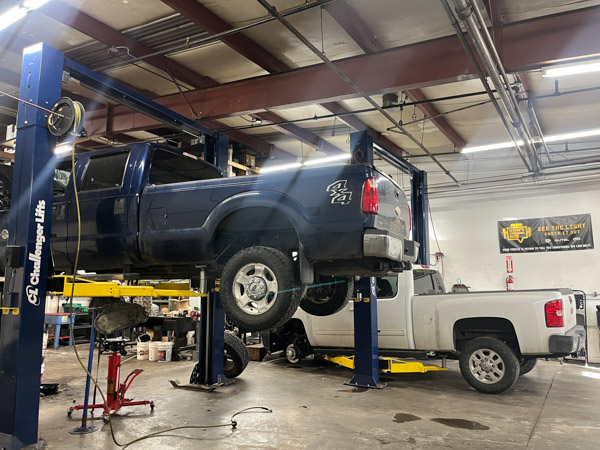
DPF diagnosis is drop-off work and typically takes 24 to 72 hours depending on workload. We call with what needs attention now, what can wait and the cost, and no work starts without your approval. See what to expect for the full visit.
Tell us what your truck is doing
Send the year, the engine and what you are seeing, and we'll get back to you as quickly as we can.
- Year, make and engine
- What it is doing, and when it started
- Any codes or recent repairs
Rather talk it through? Call (303) 808-1563
DPF questions owners ask us
What we explain at the counter.
Sometimes. If the filter is moderately loaded and the regen system works, a steady run lets a regen finish. If it is ash-loaded, cracked or the sensors are wrong, driving will not fix it.
The engine is making extra soot, the filter is full of ash, or a pressure sensor is reporting a load that is not there. A repair that does not find which one it is will not last, so we test all three.
Once in a while it is fine. Every day means regens never finish. If your trips are always short, have us look at the regen history.
Yes. Thinner air leaves less oxygen to burn the fuel, so a weak turbo or a small boost leak makes more soot at Front Range elevations than it would at sea level. The filter is often where a marginal truck shows it first, so we check boost and the air side before any DPF work.
Regen light on again? Tell us how the truck gets driven
Call with the dash messages and how often it regens, or use Request Service to send the details. Or drop us a line right here from the website and we'll get back to you as quickly as we can.