

Lift Kit Installation That Still Tracks Straight
Lift kit installation at Bodacious Diesel covers leveling kits and full suspension lifts on Ford, Chevy, GMC and Ram heavy-duty trucks, set up so the truck drives straight at highway speed. We inspect the front end first, then correct the angles the lift changes before the truck goes home.
Leveling kit or suspension lift
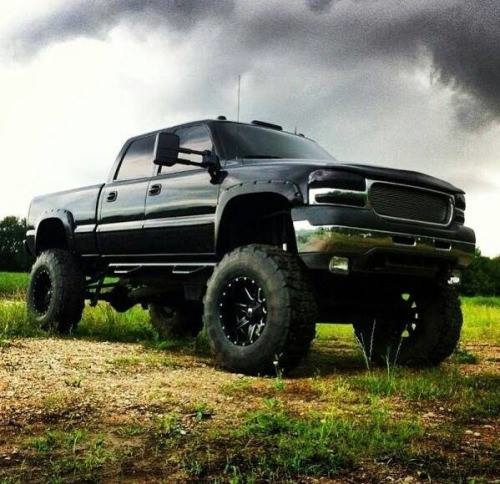
Two ways to raise a truck, each asking different things of the parts underneath. Start with how the truck gets used.
| Type | What it does | What it touches | Good fit for |
|---|---|---|---|
| Leveling kit | Raises the front to match the rear, so the nose stops sitting low. | Front spacers or springs, torsion bars on GM, alignment. | A level stance and a slightly bigger tire on a truck that still tows. |
| Suspension lift | Raises the whole truck using taller springs, lift blocks, steering knuckles or torsion keys, often a combination of them. | Springs, shocks, arms, track bar, steering, driveline, brake lines. | Ground clearance and larger tires for owners who leave the pavement. |
Tell us what the truck hauls first. A fifth wheel or gooseneck affects the hitch height and tire load rating we pick.
A proper lift corrects the angles as it goes in
Every inch of lift moves angles the factory set for stock height, and a proper lift corrects them when it goes in. If your truck was lifted somewhere else, these are what we check. Choose one to see.
Track bar, drag link and caster
On a solid front axle, the track bar keeps the axle centered. Lift the truck and the bar sits steeper, so the axle shifts sideways as the suspension moves. That causes bump steer and wandering, and a loose setup can feed death wobble.
- Track bar angle and bushing condition
- Drag link and tie rod angles
- Caster correction where the kit calls for it
- Worn front-end parts are handled by our truck suspension repair work.
Driveshafts and CV joints
A lift steepens the angle from the transfer case to each axle. Too steep and the U-joints vibrate on takeoff or at speed and wear fast. On independent front ends the CV shafts run sharper too, which shortens their life.
- Pinion angle at the rear axle
- Driveshaft length and slip yoke travel
- CV angle on independent front suspension
- Transfer case or front axle trouble goes to our 4x4 transfer case repair team.
Camber, caster and toe
Change ride height and every alignment number moves. Skip it and the truck pulls, the wheel sits crooked and new tires wear on one edge. We align at the new ride height, after the suspension settles.
- Alignment set at the final ride height
- Steering wheel centered on a straight road
- Alignment confirmed on the road test
The computer still thinks it has stock tires
Taller tires turn fewer times per mile, so the speedometer reads low. On many trucks the transmission uses that same speed signal. Programming the new tire size puts the numbers right.
- Tire size programmed with OEM factory scan tools where the truck supports it
- Speedometer checked against real road speed
- Tire load rating matched to how the truck works
Already lifted and it doesn't drive right?
Each of these complaints points to a specific part of the setup.
Wanders on the highway
Constant corrections to stay in the lane. The alignment could be off, the geometry could be wrong, or there could be loose components or a bad wheel bearing.
Crooked steering wheel
Goes straight, wheel off center. The alignment was never finished at the new height.
Vibration at speed
A buzz that builds with speed can be driveline angles, tire balance, a bad wheel bearing, U-joint or CV axle, a transfer case failure or something in the transmission.
Clunk over bumps
Loose hardware, a shock bottoming out, a sway bar link stretched too far, a bad body, engine or transmission mount, worn bushings, or anything that can move and contact something else over a bump.
Tires wearing on one edge
Camber or toe left off after the lift, or the wrong tire pressure. It eats tires fast.
Speedometer reads slow
Bigger tires, size never programmed. Left alone, it can also throw off shift timing.
Lifting a truck that still has to work
A lifted diesel often still pulls a camper or a horse trailer. Bigger tires and a taller stance change how it handles that work, and long Front Range grades show quickly whether the setup was done right, and whether the truck is being driven to match it.
- Taller, heavier tires act like a taller gear, so the drivetrain works harder on long loaded climbs
- Heavier tires take more to stop on a steep descent, so we look at the brakes too. Our truck brake repair page covers upgrades and wear.
- A bumper-pull trailer needs a drop hitch to stay level, and a fifth wheel or gooseneck needs the hitch height checked

A wrong tire size can make the truck shift at the wrong time and run the transmission hotter. If it still slips or runs hot after calibration, our diesel transmission repair work picks it up.
Four stages from stock height to road test
A lift is only as good as the truck under it, so inspection comes first.
Inspect the front end
Ball joints, tie rods, bushings and steering box play. Worn parts get flagged before the kit goes on.
Install a complete kit to spec
Parts torqued to spec, with brake lines, wiring and sway bar links checked through full travel.
Set angles and align
Driveline angles checked, then a full alignment at the settled ride height with the wheel centered.
Calibrate and road test
Tire size programmed, then a highway drive to confirm it tracks straight.
How each HD truck takes a lift
Same goal, three different front ends.
Ford Super Duty
Four-wheel-drive Super Duty trucks run a solid front axle, and on coil-spring generations a track bar keeps it centered. Getting that bar, the steering angles and caster right decides how it tracks.
Chevy and GMC HD
Independent front suspension on torsion bars. Cranking the bars is the cheap way to level, at the cost of ride and CV angle. A proper lift drops the front differential and uses new knuckles or control arms so the CV shafts and steering run at sane angles.
Ram HD
Solid front axle located by links and a track bar. Lift height changes every link angle, so adjustable parts and careful setup keep it calm at speed.
We sell lift kits and suspension components; see our diesel parts and products page, and call to confirm what fits your truck.
Why two lift jobs cost different amounts
You can spend more than you want to on a lift kit.
| Cost factor | Why it changes the job |
|---|---|
| Leveling kit or full lift | Spacers and a torsion bar adjustment are a short job next to new springs, arms and steering parts. |
| Lift height | Taller lifts add parts: longer brake lines, track bar brackets, driveline work and caster correction. |
| Front end condition | Worn ball joints or tie rods found at inspection are cheaper to replace while it is apart. |
| Tires and wheels | New tires mean mounting, balancing and programming the size into the truck. |
A lift is drop-off work: the truck stays with us through install, alignment and road test. We call with anything worn we find on the front end, and no work is done without your approval. More on our what to expect page.
Honest advice before the parts get ordered
Word for word from Google.
319 reviews
- Customer
- Colton Peterson
Big fan of bodacious. Very knowledgeable and helpful. Far and away the most honest shop I've dealt with in my adult life. They provide detailed and accurate quotes, charge fair prices, don't sell unnecessary repairs, and will even give you tips on small DIY tasks. Will be bringing the clapped out 6.6 back.5 STARS
Tell us what your truck is doing
Send the year, the engine and what you are seeing, and we'll get back to you as quickly as we can.
- Year, make and engine
- What it is doing, and when it started
- Any codes or recent repairs
Rather talk it through? Call (303) 808-1563
Before you lift it: common questions
Before you order parts, read these.
For the most part, yes, a lift will make the truck ride rougher. A leveling kit barely changes the ride; a tall lift on stiff springs feels firmer. Shocks and geometry that match the height keep it as comfortable as it can be.
Yes. Even a small change in front ride height moves toe and camber. Skip it and the truck can pull and wear tires on the edges, so an alignment is part of the job.
Yes, but it will change the way the truck handles the trailer. With a lift, the trailer has more pull on the truck, and the bigger the trailer, the bigger the difference. With a gooseneck or fifth wheel there can be clearance issues as well. Tell us what you pull before the lift kit installation.
Usually. Some cannot be fixed and have to be redone to make the system safe. We inspect the front end and driveline, correct what we can, then align and road test it.
Want it taller without the wander? Talk to us about your truck
Call with the truck, the tires you want and what it tows, or use Request Service to send the details. Or drop us a line right here from the website and we'll get back to you as quickly as we can.