

EGR Cooler Replacement for Coolant That Keeps Vanishing
EGR cooler replacement fixes a cracked cooler that is leaking coolant into the exhaust, and it only stays fixed when we know why the cooler cracked. We test first, then replace what actually failed.
Two parts, two very different failures
Exhaust gas recirculation (EGR) feeds some exhaust back into the intake to lower combustion temperature and cut NOx.
The EGR valve
A door the engine computer opens and closes, until soot makes it stick. Stuck open, the truck idles rough, smokes and pulls weak. Stuck shut, it sets flow codes and can drop into reduced power. That is a soot problem, not a coolant problem.
The EGR cooler
Exhaust is too hot to feed straight back in, so it passes through thin tubes with engine coolant flowing around them. Years of heat cycles, or one bad overheat, crack those tubes. Coolant then leaks into the exhaust side and burns off as white smoke.
We repair EGR valves and coolers so the system works as built. We do not do delete work.
What the truck tells you, and which part it points to
Coolant loss with no visible leak is the classic EGR cooler complaint. It is also a head gasket complaint, so testing comes before parts.
| What you notice | Usually points to | How we confirm it |
|---|---|---|
| Coolant level drops, no drips, no puddle | A cracked EGR cooler, or a head gasket leaking into a cylinder | Cooling system pressure test and a check for exhaust gas in the coolant |
| White smoke with a sweet smell, worst on a cold start | Coolant that leaked in overnight burning off | Checking the EGR valve and intake for coolant or white crust |
| Coolant pushed out of the overflow bottle | Exhaust or combustion pressure in the cooling system | Watching bottle pressure with the engine warm |
| Rough idle, black smoke, weak pull | An EGR valve stuck open with soot | Commanded versus actual valve position on the scan tool |
How we prove the EGR cooler is leaking
On some trucks the cooler sits deep in the engine valley. Nobody should pay for that job on a guess, so we use the testing our diesel diagnostics are built on.
- Pressure test the cooling system and watch whether it holds
- Test the coolant for exhaust gas
- Look for coolant residue at the EGR valve and intake piping
- Compare oil and coolant temperatures under load on a 6.0
Pick your engine, see what we look for
The cooler fails the same way on every engine. Why it fails, and how hard it is to reach, depends on what is under your hood.
6.0 Powerstroke: the oil cooler connection
On a 6.0, coolant passes through the engine oil cooler before it reaches the EGR cooler. When the oil cooler clogs, flow to the EGR cooler drops and it cooks until it cracks. A new EGR cooler on a 6.0 with a plugged oil cooler means doing the job twice. Head gasket trouble on this engine pushes coolant out the same way. More on our 6.0 Powerstroke repair page.
What we check on a 6.0
- Oil versus coolant temperature spread under load
- Combustion gas in the coolant
- Degas bottle pressure when warm
6.4 Powerstroke: two coolers, tight quarters
The 6.4 runs two EGR coolers and an EGR valve, packed in with the BorgWarner compound turbos. Coolant from a cracked cooler can foul the DPF downstream, so we check the filter too. Access is the big cost here. See our 6.4 Powerstroke repair page.
What we check on a 6.4
- Both coolers, not just one
- EGR valve movement and soot
- DPF for coolant contamination
Duramax: LLY and newer
The LB7 was built without EGR. From the LLY on, every Duramax carries an EGR valve and cooler. Sticking valves are the common complaint, and coolers can leak or plug. Lots of idling and short trips load the system with soot faster.
What we check on a Duramax
- EGR valve operation and soot load
- Coolant loss and exhaust gas in coolant
- What is making the extra soot
6.7 Cummins: newer trucks only
The 5.9 Cummins in Ram pickups never used EGR. The 6.7 added an EGR valve and cooler. A sticky valve throws codes and hurts drivability, and a leaking cooler loses coolant like any other.
What we check on a 6.7 Cummins
- EGR valve and its codes
- Cooler leak testing
- Soot sources upstream
Heat cycles, soot and Colorado driving
Every drive heats the cooler and every shutdown cools it, and hotter exhaust means bigger swings. When a cooler fails early, something is making extra heat or soot, and that gets fixed with the cooler. If the truck has been running hot, our truck overheating repair work covers the radiator and cooling side.
- Towing up mountain grades holds exhaust temperature high for miles
- Thin air at Front Range elevations runs exhaust temperatures higher under load
- Short winter trips on cold mornings build soot in the valve and cooler
- A failed 6.0 EGR cooler can damage the oil cooler
The replacement, step by step
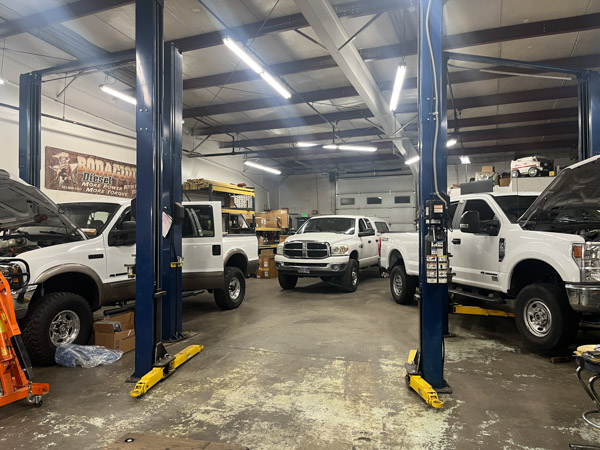
Once testing confirms the cooler, the job runs like this.
Confirm and quote
You get the test results, the cause and the cost before parts are ordered.
Tear down to the cooler
Intake, piping and turbo hardware come off as needed to reach the cooler.
Replace and clean up
New cooler and gaskets, the valve if it sticks, the 6.0 oil cooler if plugged, and the intake side cleaned.
Flush, fill and prove
Flush, refill, bleed, pressure test again and road test under load.
What customers say after the work is done
From Google, word for word.
319 reviews
- Customer
- Warren Feichtenbiner
Turbo went to hell, along with intercooler, FICM, IPR pigtail. Mel and Jeremiah worked hard to fix everything in time for me to head home. Wonderful mechanics, detailed everything for me. Great guys! Thank you so much.5 STARS
Tell us what your truck is doing
Send the year, the engine and what you are seeing, and we'll get back to you as quickly as we can.
- Year, make and engine
- What it is doing, and when it started
- Any codes or recent repairs
Rather talk it through? Call (303) 808-1563
What moves the price of an EGR cooler job
We price it after testing, because the same complaint can be a valve, a cooler or more.
| Cost factor | Why it changes the job |
|---|---|
| Engine and access | A cooler reachable from the top is a different job from one buried under the cab. |
| Valve, cooler or both | A sticking valve alone costs far less than a cooler replacement. |
| The root cause | A plugged 6.0 oil cooler or head gasket gets fixed alongside it. |
| Contamination | Coolant in the intake, oil or DPF adds cleanup. |
| Shared teardown | Other repairs behind the same parts can be done while it is apart, which saves you paying for the teardown twice. |
Diagnosis typically takes 24 to 72 hours depending on workload. We call with what needs attention now and what can wait, and no work is done without your approval. More on our what to expect page.
EGR cooler questions we hear at the counter
What owners ask when the coolant keeps dropping.
Not for long. A big leak can fill a cylinder with coolant while the truck sits, and coolant does not compress, so the next start can bend a connecting rod. Keep it topped off, watch the gauge and get it tested soon.
Both lose coolant with no puddle. We pressure test the system, check the coolant for exhaust gas and look for coolant on the EGR side. That tells us whether EGR cooler replacement, head work or both is the right fix.
Often. A failed EGR cooler can damage the oil cooler. We compare oil and coolant temperatures under load before the EGR cooler replacement, and if the spread says the oil cooler is plugged, it gets replaced in the same job.
A small crack can stay closed until the cooler gets hot. Towing up I-70 at altitude keeps exhaust hot for a long time, so that is when the leak shows. We test under load for that reason.
Adding coolant every week with no leak in sight? Let us test it
Call and tell us how much coolant you add and how often, or use Request Service to send the details. Or drop us a line right here from the website and we'll get back to you as quickly as we can.