


Diesel Turbo Repair for No Boost, Smoke and Whistles
Diesel turbo repair here starts by finding out why the boost is wrong, because a turbo rarely dies on its own. A sticking VGT, a split hose, a bad actuator and a worn bearing all feel like the same tired truck from the driver's seat. Three of those mean a new turbo: sticking vanes, a bad actuator and a bad bushing or bearing. We do not rebuild turbos; we fix trucks with bad turbos by replacing the turbo.
What the truck is doing, and what is going on inside
No boost is the complaint we test most carefully, because it is not always the turbo.
| What you notice | What is often happening | What we check |
|---|---|---|
| No boost or very little boost | A split boost hose, a VGT stuck open, a dead actuator or a damaged wheel. | Desired versus actual boost, an intake pressure test, vane movement, charge air cooler pipes and boots, intercooler condition, up pipes, and the turbo wheels where we can see them. |
| Overboost codes, surging | A VGT or wastegate stuck closed, or a bad boost sensor feeding the computer the wrong number. | Actuator command against vane position, sensors and wastegate linkage. |
| Power comes and goes, limp mode | VGT vanes sticking from soot, or an actuator that works cold and quits hot. | Boost data on a loaded road test, then the actuator and vanes. |
| Blue or gray smoke, oil in the intake | Worn turbo seals, or a restricted oil drain or crankcase pressure pushing oil past good seals. | Oil in the charge pipes, the oil drain and crankcase pressure first. |
| New whistle, siren or grinding | A boost leak whistling at a joint, or shaft play letting a wheel rub the housing. | Shaft play, rub marks on the wheels and a leak test of every joint. |
| Low power with normal boost | Not a turbo problem at all. Fuel delivery and exhaust restriction both cause this. | Rail pressure, fuel supply and exhaust back pressure, including the DPF. |
If the turbo checks out, the fault usually lives in fuel or emissions. Our diesel fuel system repair page covers the fuel side.
Exhaust spins it, and the engine breathes what it makes
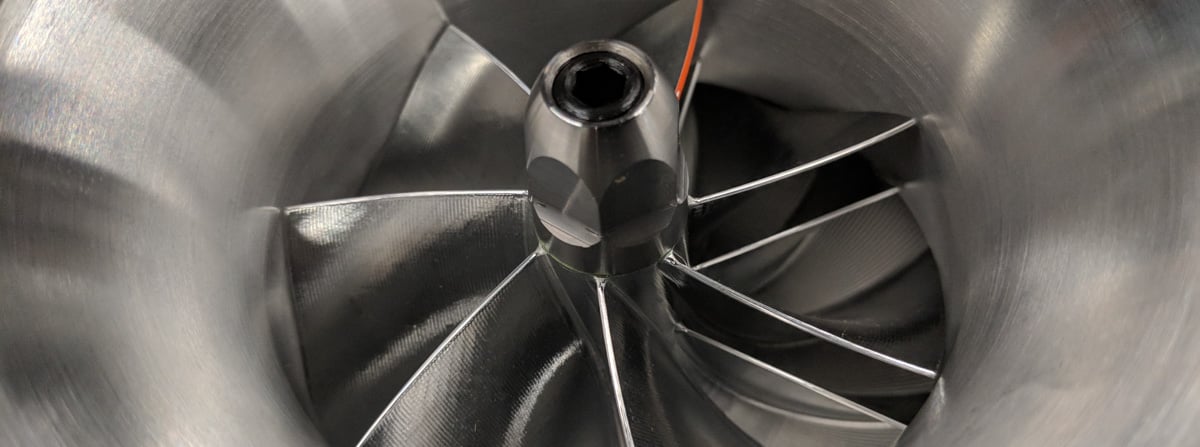
A turbo is two wheels on one shaft. Exhaust gas spins the turbine wheel, the compressor wheel on the other end packs air into the engine, and the shaft between them spins on a film of engine oil.
Fixed geometry turbos
Older diesels run a fixed-geometry turbo, often with a wastegate that bleeds exhaust around the turbine at high boost. They are simple and tough. When they fail it is usually bearings, seals or a wheel that touched its housing.
Variable geometry turbos (VGT)
Most newer trucks run a VGT. A ring of movable vanes around the turbine changes how hard exhaust hits the wheel, so the turbo spools fast down low and still flows up top. It also adds an actuator and a vane mechanism that soot can cause to stick. Vanes stuck open mean boost only at higher RPM. Vanes stuck closed can cause overboost, and can even keep the engine from starting. Either way, stuck vanes mean a new turbo.
Golden sits near 5,700 feet, and the air gets thinner on the way up I-70, so the turbo spins harder to pack in the same air. A turbo that is a little lazy at sea level shows up here as low power, smoke on a grade or a boost code.
Where Front Range driving finds a weak turbo
A long climb with a camper or horse trailer holds the turbo at high boost and high exhaust temperature for miles. That heat finds every marginal seal and actuator, and shutting down hot right after a big climb cooks oil in the bearing housing.
- Low power on long grades with a load, fine on the flat
- Boost codes that only set climbing toward the tunnel
- Smoke after a hard pull, or oil weeping at the turbo
A clogged EGR system or plugged DPF loads the VGT with carbon and raises back pressure. Then the turbo and the emissions system get diagnosed together on our diesel emissions repair side. We do not do delete work.
How we decide if the turbo is the problem
We prove a turbo is bad, and why, before anyone orders a new one.
Data under load
Codes, then desired versus actual boost and vane position on OEM factory scan tools during a road test.
Pressure test the air side
Hoses, clamps, the intercooler and the intake get pressurized to find leaks a quick look misses.
Inspect the turbo
Shaft play, wheel contact, oil on both sides, and a VGT mechanism and actuator that move freely through their full range.
Find what killed it
Oil supply and drain, debris, EGR soot and exhaust restriction. A new turbo on an old cause fails again.
A dead turbo, fixed for the trip home
From Google, word for word.
319 reviews
- Customer
- Warren Feichtenbiner
Turbo went to hell, along with intercooler, FICM, IPR pigtail. Mel and Jeremiah worked hard to fix everything in time for me to head home. Wonderful mechanics, detailed everything for me. Great guys! Thank you so much.5 STARS
Why one turbo job costs more than another
We do not quote a turbo over the phone. Low power is a boost problem first and only sometimes a failed turbo, so the price depends on what testing finds.
What drives the cost
- Whether the fix is a hose, sensor or actuator, or the turbo itself
- Fixed geometry, VGT or compound twins, and which unit your engine takes
- Access. The 6.7 Powerstroke turbo sits in the valley between the heads, and 6.4 turbo work often means lifting the cab
- Collateral damage: oil in the intercooler, debris from a broken wheel, or oil lines replaced with the turbo
- Other work sharing the same teardown, where combining repairs saves labor
Turbo testing happens on the road and in the bay, so the truck stays with us. Diagnosis typically takes 24 to 72 hours depending on workload. Then we call and explain what needs attention now, what can wait and what it costs. No work is done without your approval.
Owners bring turbo problems here when their local shop could not find the cause. The full process is on our what to expect page.
Which turbo is on your truck
Most Ford and GM diesels run Garrett turbos, with BorgWarner on the 6.4 and IHI on the LB7. Ram runs Holset. The failures follow the hardware, so here is what we see on each.
Powerstroke
The 7.3 runs a Garrett fixed-geometry turbo. The 6.0 and 6.7 run Garrett VGTs, and a 6.0 that sees short trips and EGR soot is famous for sticking vanes. The 6.4 uses BorgWarner compound twin turbos, a variable geometry high-pressure turbo and a fixed low-pressure turbo working in series.
Ford Powerstroke repairDuramax
The LB7 runs an IHI fixed-geometry turbo with no wastegate. From the LLY on, Duramax engines run Garrett variable geometry turbos, which adds vane and actuator faults to the usual bearing and seal wear.
Chevy and GMC Duramax repairCummins
The 5.9 Cummins runs wastegated Holset fixed-geometry turbos that hold up well. The 6.7 moved to a Holset VGT with an electronic actuator, When the actuator fails we replace the whole turbo, because sticking vanes are usually what made the actuator fail.
Ram Cummins repairWe sell genuine Garrett and Holset turbochargers. See them on our diesel parts and products page.
Tell us what your truck is doing
Send the year, the engine and what you are seeing, and we'll get back to you as quickly as we can.
- Year, make and engine
- What it is doing, and when it started
- Any codes or recent repairs
Rather talk it through? Call (303) 808-1563
Turbo questions truck owners ask us
What owners ask before they bring a turbo problem in.
No. A split boost hose, a loose clamp, a failed actuator, a bad sensor or VGT vanes stuck with soot all cause no boost on a healthy turbo. We check boost data and pressure test the air side first, so you only buy a turbo when the turbo is the problem.
No. We can't recommend driving a truck with a problem we haven't seen. A turbo pushing oil fills the intake and intercooler, and oil going straight into the catalytic converter or DPF can add to the bill quickly. Park it and call us.
Usually something else killed it: an oil supply or drain problem, dirt getting past the air filter, soot from the EGR side or back pressure from a plugged DPF. We find that cause before the new turbo goes on.
Some spool noise is normal on a diesel. A whistle that is new or louder than it used to be often means a boost leak, and a siren or grinding sound can mean shaft play letting a wheel rub. Have it checked before it gets louder.
It can be. Thin air and a long grade push the turbo harder than anywhere else, so a sticking VGT or a small boost leak shows up there first. Fuel and exhaust restriction can do the same, which is why we test under load before any diesel turbo repair.
Down on boost or smoking on the grades? Tell us what your truck is doing
Call with the symptoms, what you were towing and any codes you have pulled, or use Request Service to send the details. Or drop us a line right here from the website and we'll get back to you as quickly as we can.